How to choose fall protection systems for industrial work at height

Why fall protection selection starts with the hazard
Fall protection systems work best when they are matched to the task, walking surface, access route and rescue conditions. A warehouse mezzanine, roof edge, fixed ladder on a tank, loading platform and steel erection zone all involve work at height, but they do not call for the same controls. The practical sequence is straightforward: prevent the fall where possible; where it cannot be prevented, arrest it without creating a second emergency.
For industrial equipment buyers and safety teams, fall protection sits within the wider field of safety systems. The equipment only performs as intended when it is supported by engineering, procedures, training, inspection and maintenance. OSHA rules set minimum legal duties in the United States, but sound system selection also depends on the hierarchy of controls, job-specific engineering and a realistic rescue plan.

The need is still significant. Bureau of Labor Statistics data for 2024, released in 2026, reported 844 fatal falls, slips and trips across U.S. workplaces, down from 885 in 2023 but still one of the major fatal event categories. In private-sector construction, BLS reported 1,034 workplace deaths in 2024, with 389 involving falls, slips and trips, and most of those were falls to a lower level. A fall protection decision should therefore begin with exposure, not price or convenience.
Regulatory trigger points and limits to verify
OSHA’s general overview states that fall protection is required at different heights depending on the industry: 4 feet in general industry workplaces, 5 feet in shipyards, 6 feet in construction and 8 feet in longshoring operations. These figures are useful starting points, not a complete compliance determination. Specific subparts may apply to scaffolds, ladders, steel erection, powered platforms, hoist areas, holes, low-slope roofs and other special conditions.
For construction, OSHA 29 CFR 1926.501 generally requires employees on walking or working surfaces 6 feet or more above a lower level to be protected by guardrail systems, safety net systems or personal fall arrest systems, unless a more specific provision applies. For general industry, OSHA 29 CFR 1910.28 generally requires protection from unprotected sides and edges at 4 feet or more, using options such as guardrails, safety nets or personal fall protection systems.
Two details are often missed in industrial settings. First, a company performing construction-type work inside an operating facility may need to determine whether construction or general industry requirements apply to that task. Second, OSHA-approved state plans must be at least as effective as federal OSHA and may be stricter. A business with multi-state operations should not assume that one height trigger or one training document covers every site.
Fixed ladders need separate review. Under OSHA’s general industry walking-working surfaces rule, new fixed ladders and replacement ladder sections over 24 feet have required ladder safety systems or personal fall arrest systems since November 19, 2018. The rule also includes a November 18, 2036, deadline for all fixed ladders over 24 feet to have such systems. However, OSHA issued a proposed rule on April 6, 2026, to remove that 2036 retrofit deadline. As of September 5, 2026, facilities should treat this as a regulatory item to verify before approving long-term retrofit plans.
Main types of fall protection systems
Guardrail and passive protection
Guardrails are usually the preferred control where they are feasible because they protect multiple workers without requiring each person to connect, adjust and inspect personal equipment. OSHA construction criteria generally describe top rails around 42 inches above the walking or working level, with allowed tolerance and strength requirements. Permanent guardrails, temporary edge rails, hatch rails and guarded work platforms reduce reliance on individual behavior and are easier to supervise than tie-off rules alone.
Travel restraint
A travel restraint system prevents a worker from reaching the fall edge. It typically combines an anchorage, connector, lanyard or self-retracting device and body support, arranged so the user cannot travel far enough to fall. Restraint is often preferable to arrest because it avoids the fall event altogether. Its limitation is geometry. If the lanyard length, anchor location or working radius changes, a restraint setup can unintentionally become a fall arrest setup.
Personal fall arrest systems
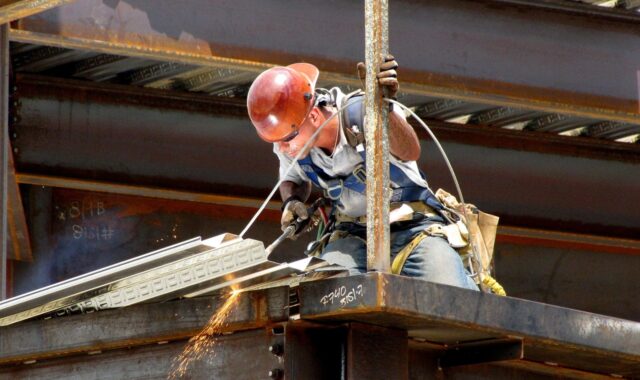
A personal fall arrest system is designed to stop a fall after it begins. A conventional setup includes anchorage, body harness and connecting device, often summarized as the ABCs of fall protection. OSHA criteria include important performance limits, such as anchorage capacity of 5,000 pounds per attached employee or a qualified-person design that maintains a safety factor of at least two. OSHA also limits maximum arresting force on an employee using a body harness to 1,800 pounds.
Fall arrest is not simply a harness purchase. The system must provide enough clearance below the worker, reduce swing-fall hazards, account for free fall and deceleration distance, and remain compatible across components. A six-foot lanyard, a low anchor and a short distance to the lower level can leave a worker connected but still exposed to striking the surface below.
Ladder safety systems
Ladder safety systems are used on fixed ladders where workers climb vertically and need continuous or near-continuous protection. They may include a carrier, sleeve and full-body harness connection. They should be evaluated against the ladder type, the transition area at the top, rescue access and user training needs. A cage alone should not be treated as equivalent to an active ladder safety system when current OSHA rules require a ladder safety or personal fall arrest system.
Safety nets and positioning systems
Safety nets may be suitable where work occurs over areas where guardrails or individual tie-off are not practical. They still require proper installation, drop testing or certification, clearance and debris management. Positioning systems support a worker on a vertical surface, such as rebar assembly or pole work, while allowing hands-free work. They are not a substitute for fall arrest unless the system is designed and used to meet the appropriate criteria.
Selection matrix for industrial work at height
| Work situation | Preferred first question | Likely system direction | Key limitation to check |
|---|---|---|---|
| Routine access to elevated platforms | Can the edge be permanently guarded? | Guardrails, gates and toe boards | Openings, swing gates and material handling gaps |
| Roof inspection or maintenance | Can workers be kept away from the edge? | Designated area, guardrail or travel restraint | Roof pitch, fragile surfaces, skylights and warning line rules |
| Tank, silo or tower ladder access | Does the fixed ladder exceed regulatory thresholds? | Ladder safety system or personal fall arrest system | Top transition, rescue method and current OSHA rule status |
| Construction leading edge | Can the fall hazard be eliminated or guarded? | Guardrail, safety net or personal fall arrest system | Changing anchor points and swing fall exposure |
| Short-duration equipment service | Can the task be moved to ground level? | Design change, lift platform or restraint | Improvised access and low-clearance fall arrest |
This matrix is not a substitute for a site-specific assessment, but it shows the basic decision path. Start with elimination and engineering controls. If workers can maintain equipment from ground level, use a platform with integrated guardrails, or relocate valves and inspection points, risk is reduced before personal equipment becomes necessary. NIOSH describes this approach through the hierarchy of controls: elimination and engineering controls generally provide more reliable protection than administrative controls and personal protective equipment alone. See also: production equipment.
Engineering details that determine real protection
Fall protection often fails in the details. A component can meet a recognized standard and still be unsuitable for a specific job. Before approving any system, safety managers should confirm at least six technical conditions.
- Anchor strength and location: The anchor must meet OSHA capacity or qualified-person design requirements, and it must be positioned to limit swing falls and free fall.
- Fall clearance: The calculation should include free fall, deceleration distance, harness stretch, connector length, worker height and a safety margin.
- Edge exposure: Leading edges and sharp edges can damage lifelines or self-retracting devices unless the equipment is rated and installed for that exposure.
- Component compatibility: Snap hooks, D-rings, lifelines, sleeves and harnesses should be used according to manufacturer instructions and should not be mixed in ways that create rollout or loading problems.
- Environmental conditions: Heat, chemicals, welding sparks, dust, salt, abrasion and ultraviolet exposure can shorten equipment life and change inspection intervals.
- User and tool weight: The combined weight of the worker, tools and clothing must fall within the system rating.
ANSI/ASSP Z359 standards are often used in the U.S. market as voluntary consensus references for fall protection equipment and systems, including self-retracting devices. For example, the Z359.14-2021 revision changed how self-retracting devices are classified and placed more emphasis on overhead versus leading-edge use. Purchasers should therefore verify the exact product label and instructions instead of relying on older terms or assumptions.
Implementation checklist for training, inspection and rescue
A fall protection system is not complete when equipment arrives on site. OSHA construction training rules require employers to train each employee who may be exposed to fall hazards so the worker can recognize hazards and understand the procedures used to minimize them. General industry rules also require training for workers who use personal fall protection systems and equipment covered by the walking-working surfaces standard.
A practical implementation checklist should include these steps:
- Map every work-at-height task, including routine, non-routine and contractor tasks.
- Identify the governing OSHA standard, state-plan rule and any owner or insurer requirement.
- Choose controls using the hierarchy of controls before selecting personal equipment.
- Have anchorages and engineered systems reviewed by a qualified person when required.
- Create written procedures for connection points, access routes, weather limits and restricted areas.
- Train workers on system use, limitations, inspection, storage and rescue actions.
- Inspect personal fall protection systems before initial use during each work shift and remove defective components from service.
- Review the plan after a fall, near miss, equipment change or change in work conditions.
Rescue planning deserves more attention than it often receives. OSHA guidance on suspension trauma warns that a personal fall arrest system can save a worker from impact while still leaving the worker suspended and unable to self-rescue. Employers should plan for prompt rescue rather than assume local emergency responders can resolve the situation after arrival. Rescue equipment, anchor access, communication, drill frequency and medical response should be considered before work begins.
Frequently asked questions
Are fall protection systems required at 4 feet or 6 feet?
Both numbers can be correct, depending on the work. OSHA generally uses 4 feet for general industry and 6 feet for construction, with different thresholds for shipyards and longshoring. Specific tasks such as scaffolds, ladders, steel erection and roof work may have additional rules, so the activity and standard must be verified.
Is a harness alone a fall protection system?
No. A harness is only one component. A complete personal fall arrest system includes suitable anchorage, body support, connectors and a design that limits free fall, arresting force, swing fall and contact with lower levels. Training, inspection and rescue are also part of making the system work in practice.
When should guardrails be chosen instead of personal fall arrest?
Guardrails are usually preferred when they can be installed without creating greater hazards because they protect everyone in the area and do not depend on each worker connecting correctly. Personal fall arrest may be necessary for changing work locations, leading edges, climbing or tasks where passive protection is not feasible.
Do existing fixed ladder cages still count as fall protection?
Facilities should verify the current OSHA rule before relying on cages. For general industry fixed ladders over 24 feet, new and replacement ladders have required ladder safety systems or personal fall arrest systems since November 19, 2018. OSHA proposed a change on April 6, 2026, affecting the 2036 retrofit deadline for existing ladders, but the proposal should not be treated as a final rule unless OSHA completes the rulemaking.
What is the biggest procurement mistake?
The biggest mistake is buying personal equipment before calculating the fall scenario. Anchor position, clearance, edge condition, rescue access and user weight can make a catalog item unsuitable. A safer procurement process begins with the task assessment and ends with equipment that is compatible with the engineered plan.