Material handling equipment guide for modern warehouses and factories

What material handling equipment means in an industrial operation
Material handling equipment is the physical and digital infrastructure used to move, store, position, protect and control materials as they pass through a factory, warehouse, distribution center or service facility. In 2026, the buying decision is rarely about one machine in isolation. It is more often about building a safer, more measurable flow of goods.
Forklifts, conveyors, cranes, lift tables, racking, automated storage systems, autonomous mobile robots, pallets, totes and control software all belong in the discussion when they affect throughput, labor demand, product damage or worker exposure to strain. For industrial managers, the practical question is straightforward: which combination of equipment reduces unnecessary handling without creating new bottlenecks, safety risks or maintenance burdens?

The answer depends on load size, route repeatability, picking profile, floor condition, aisle width, labor availability, maintenance capability and the data systems already in place. A high-speed conveyor may be valuable in one building and a costly constraint in another. A forklift offers flexibility, but it also requires trained operators, traffic controls and clear separation from pedestrians. Automation can improve consistency, but only when the physical environment is stable enough for it to perform reliably.
For more coverage of industrial machinery and factory operations, see the production equipment section.
The main types of material handling equipment
Most facilities use a mix of manual, powered and automated equipment. Grouping equipment by function helps avoid a common mistake: comparing unlike options, such as a pallet jack and a conveyor, when the real issue is the movement pattern.
| Equipment family | Typical examples | Primary role | Where it fits best |
|---|---|---|---|
| Transport equipment | Forklifts, pallet jacks, tow tractors, carts, conveyors, AGVs and AMRs | Moves materials between points | Receiving, production lines, storage, shipping and internal logistics |
| Storage equipment | Pallet rack, shelving, mezzanines, automated storage and retrieval systems | Uses floor and vertical space efficiently | Warehouses, spare parts areas, work-in-process buffers and finished goods storage |
| Positioning equipment | Lift tables, hoists, balancers, turntables, manipulators and scissor lifts | Puts work at the right height, angle or orientation | Assembly, packing, maintenance, machining support and ergonomic workstations |
| Unit load equipment | Pallets, bins, totes, containers, slip sheets and dunnage | Consolidates items into stable handling units | Any operation that moves multiple parts, cartons or components together |
| Control and identification systems | Barcodes, RFID, sensors, warehouse management systems and warehouse control systems | Tracks and directs movement | Inventory control, automated routing, traceability and performance measurement |
This framework makes gaps easier to see. A factory may already have enough lift trucks but still lose time because staging lanes are unclear. A warehouse may install automation and still rely on damaged totes that cause jams. A packaging area may have conveyors but still require workers to lift heavy cartons from below knee height. The equipment list matters, but the interfaces between equipment often matter more.
Why equipment strategy is changing in 2026
Three pressures are reshaping material handling equipment decisions: demand volatility, labor constraints and the need for better operating data. The U.S. Census Bureau reported seasonally adjusted retail e-commerce sales of about $340.2 billion for the second quarter of 2026, with e-commerce representing roughly 17 percent of total retail sales for that period. That level of online order activity keeps pressure on picking, packing, sortation and returns handling, especially in facilities originally designed for pallet or case movement rather than each-level fulfillment.
Industry survey coverage of the 2026 MHI Annual Industry Report, produced with Deloitte, also points to a more disciplined phase of supply chain technology investment. The report was based on responses from more than 500 supply chain professionals and highlighted artificial intelligence, robotics, automation, analytics and visibility tools as major areas of attention. Report summaries in industry media noted that many organizations are using or evaluating these technologies, while budget limits and the need for a clearer business case remain important barriers.
For material handling equipment, this means automation is not replacing basic engineering judgment. It raises the importance of load consistency, clean master data, reliable maintenance, pedestrian controls, charging strategy and integration with warehouse software. A robot, conveyor or automated storage system does not fix a poorly defined process. It usually exposes the weakness faster.
Choosing between manual, powered and automated movement
The right level of mechanization depends on volume, travel distance, labor availability, variability and risk. Manual carts and pallet jacks still fit low-volume or highly variable areas. Powered equipment is often the practical middle ground for heavier loads and flexible routing. Fixed automation and mobile robotics become more attractive when routes, loads and service expectations are repeatable enough to justify the investment.
| Approach | Strengths | Limitations | Good fit |
|---|---|---|---|
| Manual handling and simple aids | Low cost, flexible, easy to redeploy | Higher ergonomic exposure, limited speed and load capacity | Light loads, short distances, maintenance stores and low-frequency tasks |
| Powered industrial equipment | Handles heavier loads, flexible routing, widely understood | Requires training, traffic management, inspection and maintenance | Pallet movement, production supply, trailer loading and mixed-use warehouses |
| Fixed automation | High repeatability, strong throughput potential, good for continuous flow | Less flexible, higher upfront design effort, possible single-point bottlenecks | Sortation, packaging lines, palletizing, AS/RS and high-volume transfer paths |
| Mobile automation | Scalable, route-flexible, useful for labor reduction in repetitive travel | Needs stable floor conditions, traffic rules, fleet management and software integration | Goods-to-person picking, line-side delivery, repetitive cart movement and closed-loop routes |
A useful rule is to automate the stable part of the flow first. If orders, routes or packaging formats change every hour, start by standardizing containers, slotting and staging logic. If a route runs hundreds of times per shift with predictable loads, it may be a stronger candidate for conveyors, tow systems, automated guided vehicles or autonomous mobile robots.
Safety and ergonomics should be specified, not added later
Material handling equipment is often justified by productivity, but safety and ergonomics are central to its real value. OSHA guidance for warehousing highlights hazards associated with forklifts, conveyors, material storage, walking-working surfaces, hazardous materials and ergonomics. OSHA standard 29 CFR 1910.178 requires employers to ensure powered industrial truck operators are trained and evaluated for safe operation before assignment, with training that combines formal instruction, practical training and workplace performance evaluation.
Recent U.S. labor statistics reinforce why this matters. The Bureau of Labor Statistics table for 2024 nonfatal occupational injuries and illnesses listed warehousing and storage at 4.8 total recordable cases per 100 full-time workers. That figure does not isolate material handling alone, but it shows that warehouse environments remain injury-sensitive workplaces where equipment selection and layout have practical consequences.
Ergonomics deserves equal attention. NIOSH has long identified manual material handling as a major contributor to musculoskeletal disorders, especially tasks involving lifting, lowering, pushing, pulling and carrying. Equipment such as lift tables, vacuum assists, hoists, tilt bins, turntables and height-adjustable workstations can reduce awkward postures and excessive force. The benefit still depends on task design. A lift table placed too far from the operator, or a hoist that slows the job enough that workers bypass it, may not deliver the intended risk reduction. See also: automation systems.
- Separate pedestrian and powered-truck traffic wherever possible.
- Design aisles, rack protection and dock areas around actual turning radius and load dimensions.
- Place emergency stops, pull cords and guarding where workers can reach them during conveyor operation.
- Use lift and positioning aids where loads are heavy, frequent, awkward or handled below knee height or above shoulder height.
- Document inspections, operator authorization, maintenance intervals and incident-triggered retraining.
The physical layer determines automation performance
Automation discussions often focus on software, sensors and robotics, but the physical layer is just as important. Pallets, totes, cartons, racks, floors and charging areas determine whether automated systems run smoothly or need constant intervention. ISO 3691-4:2023, the international standard covering safety requirements and verification for driverless industrial trucks and their systems, identifies vehicles such as automated guided vehicles and autonomous mobile robots within the broader driverless industrial truck category. It also emphasizes that the operating zone affects safe operation.
That point is practical, not theoretical. Uneven floors can affect mobile robot navigation. Damaged pallets can jam conveyors or create unstable loads. Inconsistent tote dimensions can reduce automated storage reliability. Poor label placement can interrupt scanning. Congested charging zones can limit fleet availability. These issues may not appear in a vendor demonstration because they come from daily operating variation.
Before approving equipment, teams should test the real load profile: heaviest load, lightest load, damaged packaging, mixed SKU cartons, seasonal peaks, return flows and cleaning requirements. The best specification includes exceptions, not only the ideal movement path.
A practical checklist for selecting material handling equipment
A disciplined selection process reduces the chance of buying equipment that looks efficient in isolation but fails inside the full operation. The following checklist can be used for both new projects and retrofit reviews.
- Map the current flow. Record travel distance, touches per unit, waiting time, damage points, rework loops and handoffs between departments.
- Define the load. Measure weight, dimensions, center of gravity, stackability, fragility, temperature limits and packaging variability.
- Check the building. Confirm floor capacity, flatness, aisle width, column spacing, clear height, dock layout, power availability and fire protection constraints.
- Match equipment to frequency. Use simple aids for occasional moves, powered equipment for flexible heavy movement and automation for repeatable high-frequency flow.
- Evaluate safety requirements early. Include guarding, traffic separation, operator training, lockout needs, emergency access and maintenance access before final layout approval.
- Calculate lifecycle cost. Include maintenance, batteries or fuel, spare parts, downtime, software licenses, training, floor repairs and future reconfiguration.
- Plan data integration. Decide how equipment will exchange information with inventory, production, warehouse management and maintenance systems.
- Pilot with real exceptions. Test peak loads, damaged packaging, shift changes, operator behavior and maintenance response time before scaling.
The goal is not to eliminate every manual step. It is to remove unnecessary handling, reduce exposure to preventable risk and create a flow that can be measured and improved.
Frequently asked questions
What is the difference between material handling equipment and production equipment?
Production equipment changes the product through processing, assembly, forming, machining, packaging or testing. Material handling equipment moves, stores, positions or controls the material before, between and after those value-adding steps. In many plants, the two overlap at conveyors, feeders, palletizers and line-side storage systems.
When should a facility consider automated material handling equipment?
Automation is worth evaluating when movement is frequent, routes are repeatable, labor availability is constrained, service expectations are rising or manual handling creates avoidable ergonomic risk. It is less attractive when load types, routes or order patterns are highly unstable and have not yet been standardized.
Does a forklift count as material handling equipment?
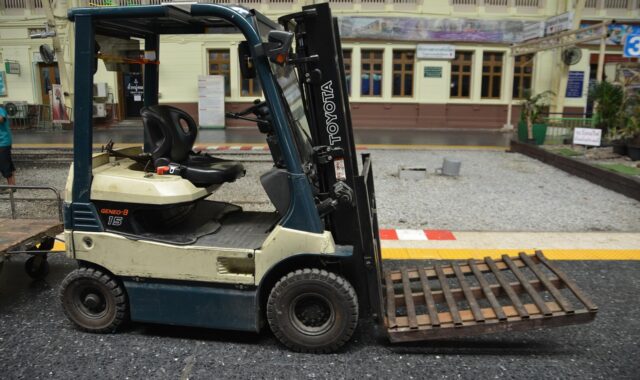
Yes. Forklifts are one of the most common forms of powered material handling equipment. They are flexible and productive, but they also require operator training, inspection, maintenance and traffic controls, especially where pedestrians, racks and dock operations share the same space.
What should be reviewed before installing conveyors or robotics?
Review load dimensions, packaging quality, floor condition, emergency access, guarding, software integration, maintenance staffing, spare parts, cleaning requirements and how exceptions will be handled. A system that works only with perfect loads may struggle in daily industrial use.
How can material handling equipment improve ergonomics?
It can reduce lifting, carrying, pushing, pulling, twisting and awkward reach when properly matched to the task. Examples include lift tables, hoists, manipulators, vacuum assists, tilt bins, turntables and conveyors set at appropriate working heights. The equipment must be convenient enough that workers use it consistently.