Are Automation Systems Worth It for Modern Industrial Equipment Buyers?

What Should You Expect from Modern Automation Systems?
Modern automation systems are not only for large car plants or high-volume electronics factories anymore. When you buy industrial equipment today, you are often buying the control platform, data path, safety setup, and service support together with the machine. The job is still straightforward: let machines repeat work with less variation, show operators what is happening, and help managers deal with a fault before it turns into a lost shift.
Repeatable Machine Control
A good automation system keeps motion, timing, temperature, pressure, filling, cutting, sorting, or packaging inside the set range. This sounds basic, but many real production gains start there. For example, a packaging line may be rated at 45 cycles per minute, yet poor product feeding can still cause jams and lost output. In many cases, better sensors, servo control, and recipe management bring more value than simply pushing the line to run faster.
Real-Time Production Data
You should be able to see live data for machine status, alarms, cycle count, reject count, energy use, and stoppage reasons. Deloitte’s 2025 Smart Manufacturing Survey reported that 57% of manufacturers were using cloud computing at facility or network level, 57% were using data analytics, 46% were using IIoT, and 42% were using 5G. For equipment buyers, the message is plain enough: data capture is now part of normal factory equipment, not a nice extra on the side. (deloitte.com)
Safer Operator Workflows
Automation should also make daily work safer and less tiring for operators. Guarding, interlocks, light curtains, emergency stops, safe torque off, and clear HMI messages reduce guessing around moving equipment. You still need proper lockout rules and trained people, because no system can fix poor habits by itself. Even so, well-planned controls can stop many small mistakes before they become injuries, scrap, or damaged machine parts.
Why Are Automation Systems Becoming a Buying Priority?
This is not just a trend that looks good in a sales deck. Buyers are dealing with tighter delivery dates, stricter quality checks, labor gaps, and higher downtime costs. A simple semi-automatic machine can still be the right choice for a small batch workshop. For a plant shipping daily orders, though, automation systems can protect margin in places that are easy to overlook during the first equipment quote.
Robot Demand Keeps Growing
The International Federation of Robotics said its World Robotics 2025 data showed 4.664 million industrial robots in operation worldwide in 2024, up 9% from the year before. China alone installed 295,000 industrial robots in 2024 and represented 54% of global deployments. These figures do not mean every buyer should order a robot right away. They do show that automated production is becoming a normal benchmark in more industries. (ifr.org)
Downtime Costs Are Harder to Ignore
Downtime is where automation costs become easy to understand. Siemens’ 2024 True Cost of Downtime report estimated that an average large plant in the surveyed sectors loses 27 hours per month to unplanned downtime and about $253 million per year. In large automotive plants, Siemens estimated downtime at $2.3 million per hour. Your plant may be much smaller, but the same cost pattern still applies: lost time carries labor, delivery, scrap, repair, and customer penalty costs. (assets.new.siemens.com)
Labor and Skills Pressure
Automation also helps when skilled operators are hard to hire or hard to keep. Deloitte reported that U.S. manufacturing could need as many as 3.8 million net new employees by 2033, while 85% of surveyed manufacturers agreed that smart manufacturing can make the industry a more attractive career path. For a buyer, this points to one practical rule. Equipment should not depend on one strong operator who knows every workaround by memory. (deloitte.com)
Which Components Matter Most in an Industrial Automation System?
A complete automation system works like a stack. Field devices collect signals, the controller makes decisions, the drive system moves the machine, and software records what happened. If one layer is weak, the whole system feels awkward in daily use. That is why a careful buyer looks past the machine frame and asks how the controls, data, and service plan fit the production plan.
PLCs, HMIs, and Drives
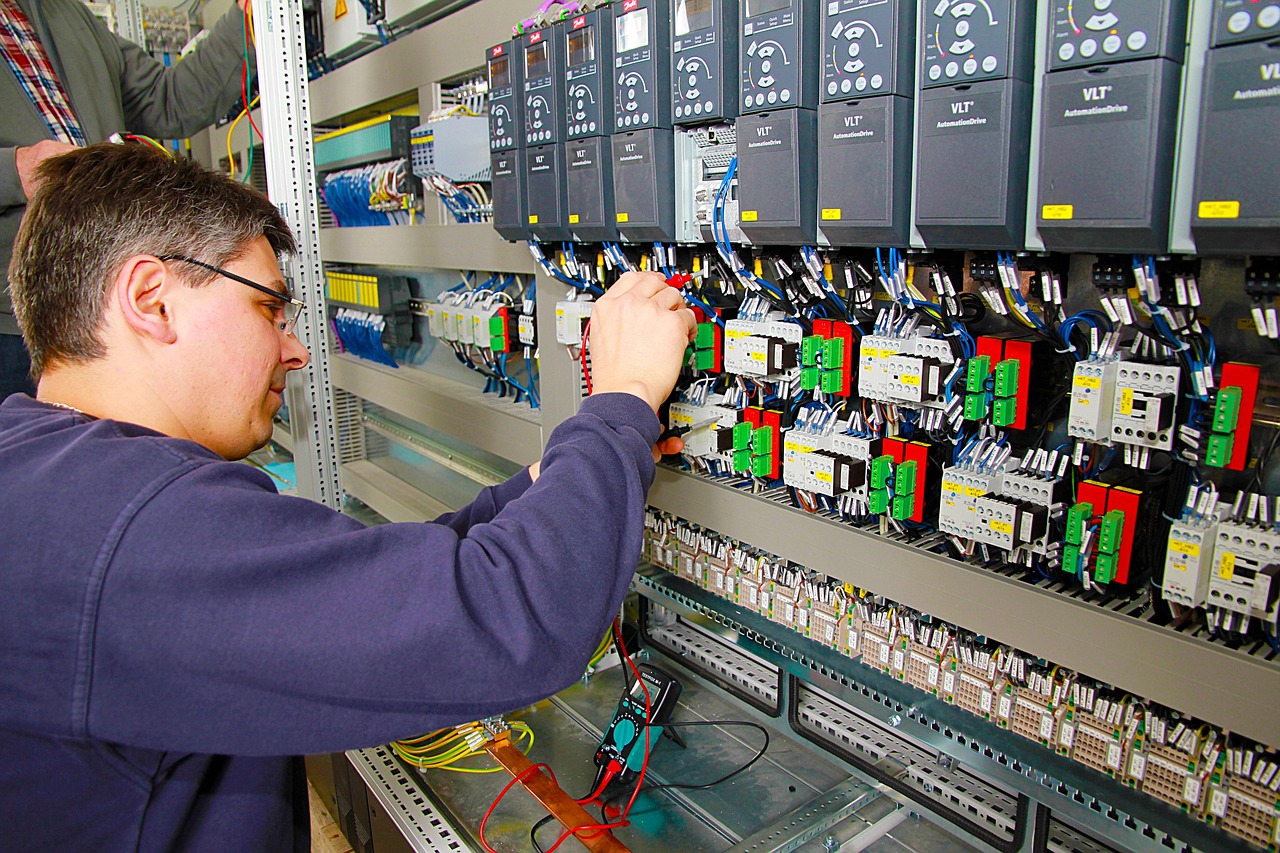
The PLC or PAC is usually the main controller. It reads inputs, runs logic, and sends outputs to valves, motors, heaters, cylinders, or drives. The HMI gives operators recipes, alarms, status pages, and manual controls, while drives and servo systems handle speed, torque, and position. When these parts match the process, the line runs in a steady way. When they do not, operators keep opening panels, resetting alarms, and complaining at the screen. It happens more often than buyers expect.
Sensors, Vision, and Robots
Sensors tell the system what is present, missing, hot, cold, full, empty, aligned, or out of position. Vision systems check labels, dimensions, color, orientation, fill level, or surface defects. Robots can load, unload, weld, palletize, dispense, inspect, or move parts between stations. The right component choice depends on the product, cycle time, part variation, and cleaning needs, so a dusty foundry cell and a food packaging line should not be built with the same hardware plan.
SCADA, MES, and Data Layers
ISA-95, from the International Society of Automation, gives a useful model for connecting control systems with business systems. Its framework separates physical processes, sensing and control, manufacturing operations, and business planning. ISA says the model helps reduce risk, cost, and errors when control functions and enterprise functions exchange information. In simple terms, machine data should not end up as a messy spreadsheet that nobody on the floor trusts. (isa.org)
How Do Automation Systems Improve Quality and Throughput?
Better quality does not always come from faster machines. It often comes from steadier process control and quicker reaction when the process starts to drift. If the first bad part is found after 2,000 pieces, the loss hurts. If the line catches the change after 20 pieces, the shift can still be saved.
Stable Cycle Times
Stable cycle time makes planning easier. If a machine runs one part in 12 seconds, then 16 seconds, then stops for 3 minutes because a part tilted sideways, the average output drops quickly. Automation systems can set controlled motion profiles, monitor buffer levels, and keep feed equipment in rhythm. Sometimes a simple accumulation table or reject chute saves more time than an extra robot. Anyone who has spent time on a line has seen that kind of surprise.
Faster Fault Detection
Good fault detection points workers to the source, not only the symptom. Instead of showing a broad alarm such as Line Stop, the HMI should show a failed photoeye, low air pressure, servo following error, open guard door, or missing part at station three. Maintenance teams can then fix the cause faster and avoid checking every station one by one. This matters even more on night shifts, when the most experienced technician may not be on site.
Traceable Production Records
Traceability gives you proof when a customer, auditor, or warranty team asks what happened. Batch numbers, timestamps, operator login, process values, reject images, torque records, or test results can support customer audits and warranty reviews. World Economic Forum research from 2025, based on more than 1,000 industrial transformation cases, found that successful transformations often start from pain points such as downtime, scrap, or missed delivery windows. That fits shop-floor work: traceability is useful because it helps you find the weak spot instead of arguing from memory. (weforum.org)
What Should You Check Before Choosing a Supplier?
The supplier decision should not start with a shiny catalog. Start with the process and the problems you need to solve. A cheaper system can become expensive if it cannot handle your product tolerance, cleaning method, air quality, voltage, spare parts needs, or local maintenance skill. Before signing, ask the plain questions. Those questions are not exciting, but they save money.
Process Fit Before Brand Choice
List the product sizes, materials, weights, speeds, reject standards, duty cycle, shift pattern, and environmental limits. Then ask the supplier to explain how the system will run the worst case, not only the sample part on a clean demo table. If there are many SKUs, recipe control and tool-free changeover may matter more than maximum speed. This is where a practical process review usually beats brand-first buying.
Integration with Existing Equipment
Most plants do not install automation in an empty room with no old equipment around it. You may need to connect conveyors, printers, scales, metal detectors, chillers, compressors, warehouse systems, or ERP software. Check communication protocols, I/O capacity, space, guarding, cable routing, and data format early. A 30-minute talk about interfaces can prevent weeks of trouble during commissioning.
Service, Spares, and Training
Ask who supports the system after delivery, which parts are standard, and how fast spares can arrive. Training should cover operators, maintenance staff, and supervisors, not only one engineer who may leave the company later. A short checklist helps:
- Electrical drawings and program backup are delivered.
- Critical spare parts are listed with model numbers.
- Alarm messages are written in useful language.
- Operators can run changeovers without calling engineering every time.
- Maintenance staff can recover safely after common faults.
How Can You Reduce Risk During Implementation?
Automation projects often fail when the scope is unclear, the data is weak, or the people who will run the line are brought in too late. A safer path is to set a narrow goal, measure the baseline, test the line under real conditions, and train the people who will use the equipment every day.
Pilot Cells with Clear KPIs
Pick a pilot area where the pain is easy to see: repeated jams, high scrap, heavy lifting, slow inspection, or poor changeover. Set a few clear KPIs such as output per hour, first-pass yield, downtime minutes, changeover time, or labor hours per batch. No public dataset can give the exact ROI for every plant, because product mix and local costs vary too much. Your own baseline is the number that should guide the decision.
Cybersecurity by Design
Connected automation needs cybersecurity from the start, not after the machine is already on the shop floor. NIST’s Cybersecurity Framework 2.0, published in 2024, gives guidance for organizations to manage cybersecurity risk and communicate security work across teams. For industrial buyers, that means user roles, backups, network segmentation, remote access rules, patch planning, and vendor access logs should be discussed before the machine ships. If remote support is needed, the access method should be agreed in writing.
Operator Training and Maintenance Rules
People still make automation work. The World Economic Forum reported in 2025 that 75% of sites investing in workforce capabilities achieved above-median performance, and sites with structured skill programs scaled initiatives 2.5 times faster. Give workers time to learn the system, not just a rushed handover on Friday afternoon. The clipboard beside the line may look old-school, but clear shift notes still help during a busy week. (weforum.org)
FAQ
Q1: Are Automation Systems Only for Large Factories? A: No. Small and mid-sized plants can use automation for feeding, inspection, packing, labeling, or data collection. The key is to target a clear bottleneck instead of automating everything at once.
Q2: How Do You Know If Automation Is Worth the Cost? A: Compare the system cost with labor savings, scrap reduction, downtime reduction, higher output, safety gains, and customer requirements. Use your own production data where possible.
Q3: What Is the Biggest Mistake When Buying Automation Systems? A: The biggest mistake is choosing hardware before defining the process. Product variation, cleaning, maintenance skill, cycle time, and data needs should guide the design.
Q4: Do Automation Systems Need Internet Access? A: Not always. Many systems can run locally. If remote support, cloud dashboards, or multi-site reporting are needed, access should be controlled with strong cybersecurity rules.
Q5: How Long Does an Automation Project Take? A: Simple machine upgrades may take weeks. Full production cells can take several months, including design, build, testing, shipping, installation, commissioning, and operator training.