Mechanical material handling systems for industrial facilities and warehouses
Mechanical material handling refers to the use of engineered equipment—such as conveyors, cranes, hoists, lift trucks, palletizers, automated storage systems, and mobile robots—to move, store, lift, orient, or control materials in an industrial operation. The best choice is rarely a single machine selected in isolation. It depends on load characteristics, travel distance, process rate, facility layout, maintenance capability, software needs, and the safety controls required for the work area. For more industrial equipment topics, visit the material handling category.
What mechanical material handling means
Mechanical material handling sits between purely manual handling and fully automated logistics. It includes equipment that reduces human lifting, carrying, pushing, pulling, stacking, or positioning effort, but it does not always mean a lights-out facility. A manually driven forklift, an overhead crane with pendant control, and a powered conveyor line are all mechanical handling solutions. An autonomous mobile robot or an automated storage and retrieval system adds a higher level of control and automation, but it still belongs to the broader mechanical handling category.
The core purpose is to move the right material to the right place, in the right orientation, at the right time, with fewer unnecessary touches. In manufacturing, that may mean feeding components to a work cell. In warehousing, it may involve receiving pallets, moving cartons to storage, replenishing pick faces, or sorting outbound orders. In heavy industry, it can include lifting coils, dies, drums, castings, sheets, bags, or bulk containers that cannot be handled safely by people alone.
A practical way to evaluate the topic is to separate four functions: transport, lifting, storage, and positioning. Transport moves loads horizontally. Lifting changes elevation. Storage controls where materials wait. Positioning presents the load for processing, inspection, packing, or assembly. Many systems combine more than one function, which is why early layout and workflow analysis matters.
Main types of mechanical material handling systems
The most suitable system depends on whether the load is a pallet, carton, tote, container, roll, sheet, drum, component, or bulk material. It also depends on whether the movement is fixed-route or flexible-route, intermittent or continuous, light-duty or heavy-duty, and whether the environment involves clean-room, cold-storage, or hazardous-area conditions.
| System type | Typical role | Best fit | Key limitation |
|---|---|---|---|
| Conveyors and sortation | Move cartons, totes, parcels, parts, or pallets along defined paths | Repeatable flow with predictable routes and steady volume | Less flexible when routes, SKUs, or building layouts change often |
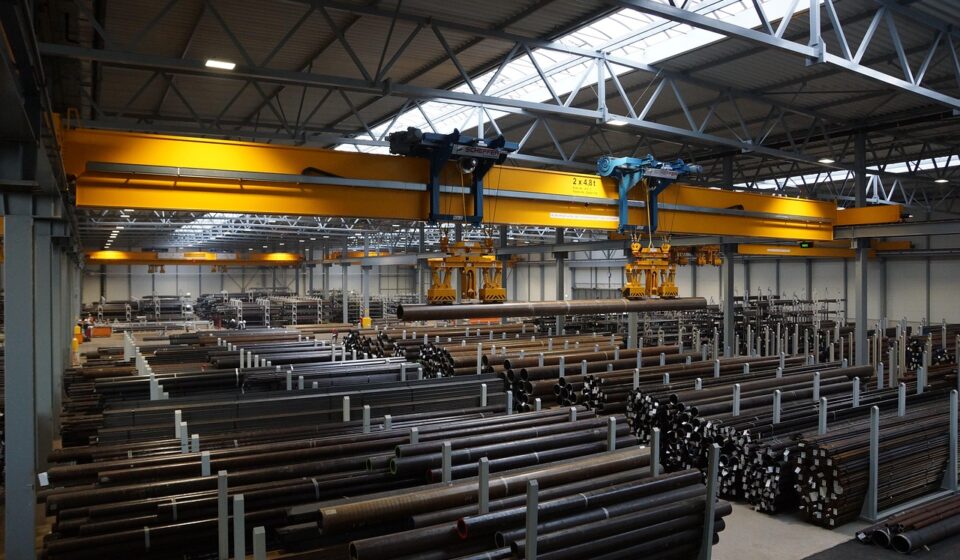
| Cranes, hoists, and monorails | Lift and position heavy or awkward loads | Machine loading, maintenance bays, steel handling, tooling, and assembly | Requires structural review, safe rigging practices, and defined operating zones |
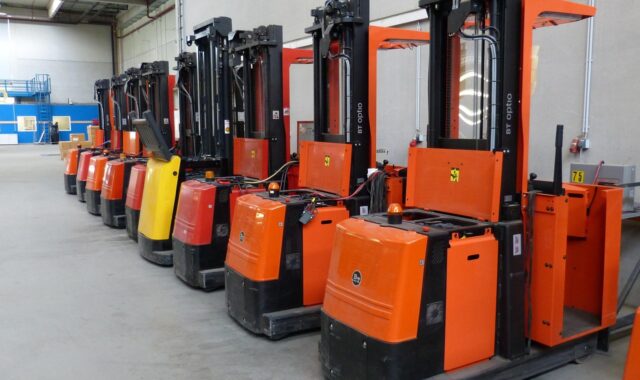
| Forklifts and powered pallet trucks | Move and stack pallets or containers | Flexible movement in receiving, shipping, storage, and production supply | Traffic risk, operator training, battery or fuel management, and aisle requirements |
| Vertical lifts and mezzanine lifts | Move goods between elevations | Facilities using mezzanines, multi-level storage, or compact layouts | Throughput can be limited by cycle time and loading method |
| AS/RS and shuttle systems | Store and retrieve goods with mechanized or automated equipment | High-density storage, controlled inventory, and repeatable SKU profiles | Higher integration complexity and stronger need for reliable data |
| AGVs and AMRs | Move loads through guided or autonomous routes | Replenishment, line-side delivery, goods-to-person flow, and repetitive transport | Requires traffic planning, system integration, and clear exception handling |
| Manipulators and lift assists | Help operators lift, rotate, balance, or place loads | Ergonomic improvement at workstations and repetitive handling points | Often solves a local problem rather than a full facility flow issue |
In many facilities, the strongest design is a hybrid. Forklifts may remain useful at docks, conveyors may handle high-volume carton movement, and lift-assist devices may reduce ergonomic strain at packing or assembly stations. The objective is not to mechanize every task; it is to remove the manual steps that create the most cost, risk, delay, or capacity constraint.
Where mechanical handling creates the most value
The business case is usually strongest when a handling task is frequent, predictable, physically demanding, or tied to a production bottleneck. Moving one unusual load per month rarely justifies a complex system. Moving thousands of cartons per shift, lifting heavy parts every few minutes, or covering long travel distances for routine replenishment may justify a closer review.
- High repetition: Repeated lifting, carrying, or pallet movement can justify conveyors, lift assists, pallet trucks, or robots.
- Long travel distance: If operators spend more time walking or driving than doing value-added work, route-based equipment can improve flow.
- Heavy or awkward loads: Cranes, hoists, vacuum lifters, and manipulators help control loads that are difficult to hold safely by hand.
- Space pressure: AS/RS, vertical lifts, and narrow-aisle equipment can improve cube utilization where floor area is constrained.
- Throughput constraints: Conveyors, sorters, palletizers, and automated transport can stabilize flow when manual methods cannot keep pace.
- Quality and damage concerns: Controlled handling reduces drops, impacts, incorrect orientation, and excessive touches.
- Traceability needs: Systems connected to WMS, WCS, MES, or ERP platforms can improve location accuracy and transaction records.
Mechanical handling also changes the work profile. It can reduce some manual strain while introducing new responsibilities in inspection, traffic management, controls support, maintenance, and safe intervention. A project plan should account for training, spare parts, supervision, and operating discipline, not just the equipment purchase price.
Safety and compliance issues that shape every design
Safety cannot be added at the end of a mechanical material handling project. It affects aisle width, clearance, guarding, traffic flow, control reliability, lockout procedures, training, signage, emergency access, and maintenance methods. OSHA general industry requirements for materials handling and storage include safe clearances where mechanical handling equipment is used, clear and maintained aisles, marked passageways, stable storage, and hazard control in storage areas. OSHA rules for powered industrial trucks cover design, maintenance, operation, and operator training. OSHA machine guarding requirements are also relevant where conveyors, rotating parts, nip points, and moving machine elements can expose workers to injury.
For automated or semi-automated equipment, standards and consensus guidance become especially important. ISO 3691-4 addresses safety requirements for driverless industrial trucks and their systems, including equipment categories such as AGVs and AMRs. ANSI/ASSP Z244.1 covers control of hazardous energy through lockout, tagout, and alternative methods. These references do not replace site-specific risk assessment, but they help frame the questions that integrators, safety teams, and operations leaders should ask.
Common hazards include struck-by incidents involving lift trucks or moving loads, caught-in or pinch-point hazards on conveyors, falling materials from unstable storage, poor visibility at intersections, unexpected startup during maintenance, overloaded lifting devices, and unsafe manual intervention after a jam. Practical controls are usually layered: eliminate unnecessary handling, separate people from equipment where possible, guard moving parts, manage traffic, define lockout procedures, train operators, and inspect equipment routinely.
How to select a mechanical material handling system
A sound selection process starts with material and process data, not with equipment catalogs. The first step is to document what moves, how often it moves, where it starts, where it ends, how it is stored, and what happens when normal flow is interrupted. Without this baseline, it is easy to overspend on automation or underspecify equipment that later becomes a bottleneck.
- Define the load: Record dimensions, weight range, center of gravity, surface condition, fragility, stackability, temperature, cleanliness, and packaging variability.
- Map the flow: Identify origin, destination, travel distance, elevation changes, intersections, waiting points, and peak-hour demand.
- Measure the rate: Use units per hour, pallets per shift, lines per order, or production takt time rather than broad estimates.
- Review the layout: Check aisle widths, dock constraints, ceiling height, column spacing, floor condition, fire egress, and maintenance access.
- Assess risk: Evaluate manual handling strain, vehicle interaction, machine hazards, stored-energy hazards, and foreseeable misuse.
- Plan integration: Decide whether the system must connect with WMS, WCS, ERP, MES, scanners, sensors, or quality systems.
- Compare lifecycle cost: Include energy, batteries, maintenance, spare parts, downtime, training, controls support, and future modifications.
- Pilot where uncertainty is high: Use trials, simulations, phased zones, or proof-of-concept testing before committing to a full rollout.
One practical rule is to match the level of automation to the stability of the process. Fixed conveyors can work well for stable, high-volume routes. Mobile robots may be attractive where routes change and installation disruption must be limited. Cranes and hoists are often more appropriate than forklifts when loads must be precisely positioned, not simply transported. Lift assists may provide faster payback than complex automation when the main issue is workstation ergonomics. See also: production equipment.
Current direction of the industry
Industry organizations and trade publications continue to describe a shift toward modular, phased, and data-connected handling systems. MHEDA’s 2026 business trends material highlights customer interest in phased automation strategies that can show measurable returns at each stage. MHI’s 2026 industry report theme also points to innovation, supply chain technology, and operational transformation. Modern material handling surveys published for 2026 have reported continued interest in conveyors, sortation, lift trucks, storage systems, robotics, and warehouse software, while also noting caution around budgets and business-case clarity.
The practical implication is that mechanical material handling decisions are becoming less isolated. A conveyor is no longer just a conveyor when it must exchange data with scanners, print-and-apply systems, sortation logic, and warehouse software. A lift truck fleet may involve telematics, battery management, traffic analytics, and operator access control. AMRs and AGVs require fleet management and coordination with human work zones. Even basic equipment choices can affect data quality, maintenance scheduling, and future automation options.
For many facilities, the strongest approach is to modernize in layers. First, stabilize storage, aisle discipline, work methods, and data accuracy. Second, remove obvious ergonomic and safety risks. Third, mechanize high-frequency transport or lifting tasks. Fourth, integrate controls and software where the process is stable enough to benefit. This sequence reduces the risk of automating a poor process.
Practical checklist before requesting quotes
Before asking suppliers for proposals, a facility should prepare a concise but detailed application brief. This helps vendors compare the same operating conditions and reduces the risk of proposals being based on assumptions that later become change orders.
- List product families, load sizes, weights, and packaging types.
- Provide current and expected volumes, including seasonal or shift peaks.
- Share drawings showing columns, docks, doors, fire exits, mezzanines, and utilities.
- Identify safety requirements, traffic separation needs, and maintenance access expectations.
- Explain the current pain point: labor availability, injury risk, throughput, accuracy, space, damage, or downtime.
- State software and controls requirements, including whether integration is required now or reserved for a later phase.
- Ask for assumptions on uptime, spare parts, preventive maintenance, training, commissioning, and acceptance testing.
- Request a clear definition of what is included and excluded from the scope.
A proposal should not be judged only by purchase price. A lower-cost solution that requires constant manual intervention, blocks maintenance access, or cannot handle peak demand may cost more over its operating life. A higher-capacity system may also be wasteful if process volume is uncertain. The best choice is the one that fits the actual material flow, manages risk, and leaves the operation flexible enough to adapt.
Frequently asked questions
Is mechanical material handling the same as automation?
No. Automation is one possible level of mechanical handling, but the terms are not identical. A forklift, hoist, or manually controlled crane is mechanical handling even if a human operator controls it. Automated systems add sensors, controls, software, and decision logic to reduce manual driving or handling.
Which system is best for a small warehouse?
A small warehouse often benefits first from better layout, pallet flow, ergonomic lift assists, powered pallet trucks, dock equipment, and selective conveyor use. Full automation may make sense only when volume, labor constraints, accuracy needs, or space limitations justify the added integration and maintenance effort.
What information is needed to size a conveyor or lift system?
Useful inputs include load dimensions, maximum and average weight, required rate, route length, elevation change, accumulation needs, operating hours, environment, control requirements, and available space. For lifting systems, center of gravity, attachment method, duty cycle, and structural support are also critical.
How should safety be handled during system upgrades?
Safety should be part of the earliest design review. The project team should evaluate traffic flow, guarding, emergency stops, lockout procedures, stored energy, training, maintenance access, signage, and foreseeable abnormal conditions such as jams, blocked sensors, or manual recovery after a fault.
Can mechanical handling reduce labor needs?
It can reduce manual travel, lifting, and repetitive transport, but it does not eliminate the need for people. Work often shifts toward supervision, exception handling, equipment inspection, maintenance coordination, data management, and process improvement.