How to choose spraying equipment for industrial coating lines
Quick answer for specifying spraying equipment
Choose spraying equipment around the coating material, substrate, part geometry, production rate, finish tolerance, containment needs and regulatory duties. On an industrial coating line, the decision is seldom limited to a spray gun or pump. The specification usually covers atomization, fluid delivery, booth or enclosure design, ventilation, filtration, overspray control, curing or drying, operator protection, cleaning and inspection.
A buyer comparing production equipment should first identify whether the process is liquid coating, powder coating, thermal spray or maintenance touch-up. The next step is to match the equipment package to measurable quality and safety requirements. A reliable specification is documented, testable and tied to the coating supplier’s data sheet.
Start with the coating process, not the catalog
The same word, spraying, can describe very different production processes. Liquid paint spraying uses atomized droplets of primer, topcoat, adhesive, release agent or protective coating. Powder coating uses charged dry powder particles that are deposited on a grounded part and then cured. Thermal spraying projects heated or molten material onto a prepared surface to build a functional coating. Each process has different needs for air, power, grounding, extraction, filtration and inspection.
For general metal fabrication, machinery, automotive components, agricultural equipment and industrial maintenance, liquid spraying is often selected because coatings are widely available and color changes can be handled with established procedures. Powder coating can be efficient for high-volume conductive parts when color schedules, oven capacity and pretreatment are well controlled. Thermal spray sits in a more specialized category. ISO 2063 covers zinc, aluminium and alloy thermal-sprayed coatings for corrosion protection, which shows that the process is closer to engineered surface protection than ordinary paint application.
Before selecting equipment, define the coating material’s viscosity, solids content, pot life, recommended tip size, allowable thinning, film build, flash time, cure schedule and hazard profile. A coating that works through one delivery method may not atomize, level or cure correctly through another. Poor matching can lead to orange peel, dry spray, pinholes, sagging, low film build, weak adhesion or excessive overspray.
Compare the main spraying equipment types
| Equipment type | Common use | Main advantage | Important limitation |
|---|---|---|---|
| Conventional air spray | Fine finishing, small batches, detailed work | Good atomization and operator control | Can create high overspray and may not be acceptable in some regulated operations without controls |
| HVLP spray | Automotive refinishing, furniture, metal parts, controlled finishing | Designed for higher transfer efficiency than conventional air spray | May be slower on large surfaces and sensitive to air supply quality |
| Airless spray | Large steel structures, tanks, frames, heavy coatings | High output and strong film build | High-pressure injection hazard; finish quality depends heavily on tip selection and technique |
| Air-assisted airless spray | Industrial parts requiring output and better finish | Combines airless delivery with air shaping | Requires tuning of both fluid pressure and assist air |
| Electrostatic liquid spray | Conductive, grounded parts with repeatable geometry | Can improve wrap and reduce wasted coating when grounding is correct | Needs strict grounding, material compatibility and fire-safety controls |
| Powder spray equipment | High-volume metal products and durable finishes | Overspray powder can often be recovered if contamination is controlled | Requires pretreatment, curing capacity and color-change discipline |
| Robotic or reciprocator spraying | Repeatable production lines | Improves consistency and reduces operator exposure in the spray zone | Needs fixturing, recipes, maintenance skill and programming discipline |
| Thermal spray | Corrosion, wear or dimensional restoration coatings | Builds functional metallic or ceramic coatings | Requires specialist surface preparation, dust control, noise control and inspection |
This comparison is not a ranking. The right spraying equipment is the type that can meet the line’s finish specification, productivity target and control obligations at the same time.
Match atomization and transfer efficiency to the part
Atomization is the process that breaks coating into a controlled spray pattern. In production, the evaluation should include fan pattern, droplet size, edge coverage, recess coverage, wet film build, repeatability and overspray. Transfer efficiency matters because wasted coating increases material cost, booth loading, filter use and emissions. Even so, the highest theoretical transfer efficiency does not automatically produce the lowest total cost if it causes rework, slows the cycle or creates uneven film thickness.
Part geometry is one of the largest practical variables. Flat panels, pipe, structural members, cabinets, castings and welded frames do not behave the same in a spray booth. Large flat surfaces may favor airless or air-assisted airless equipment for output. Complex conductive parts may benefit from electrostatic application if grounding is reliable. Small or cosmetic parts may need HVLP or well-tuned air spray to control appearance.
The U.S. EPA’s 40 CFR Part 63 Subpart HHHHHH, often called the 6H rule, is a useful example of how regulators treat application method. For covered paint stripping and miscellaneous surface coating area sources, spray-applied coatings must generally be applied with HVLP, electrostatic, airless, air-assisted airless or an approved equivalent technology. This does not mean the same rule applies to every factory, but it shows why equipment selection should be documented rather than treated as a purely purchasing decision.
Booth, ventilation and fire protection are part of the system
A spray gun without a controlled spray area is incomplete. OSHA 29 CFR 1910.107 defines a spray booth as a power-ventilated structure that confines spray operations and directs vapors and residues to an exhaust system. For covered spray finishing using flammable and combustible materials, the OSHA standard addresses mechanical ventilation, independent exhaust, grounding of metal booth and piping parts, and automatic fire protection where available or approved alternative extinguishing equipment where it is not.
NFPA 33 is the key U.S. consensus standard for spray application using flammable or combustible materials. Its requirements should be reviewed with qualified safety, engineering and code professionals when designing or modifying a booth. Important topics include enclosure construction, electrical classification, ventilation interlocks, ignition-source control, fire suppression, powder handling and housekeeping. A booth that appears adequate from the outside may still fail if air movement creates dead zones, filters are overloaded, doors are open during spraying or exhaust discharge creates a nuisance or re-entrainment problem.
Ventilation also affects finish quality. Too little airflow can allow mist and solvent vapor to accumulate. Too much airflow, or airflow aimed poorly, can disturb the spray pattern and cause dry spray. Makeup air temperature and humidity can affect viscosity, flash-off and curing. For consistent results, the equipment specification should include booth airflow, filter pressure drop, air balance, lighting and maintenance access.
Surface preparation decides whether the coating will last
Spraying equipment cannot compensate for a surface that is oily, contaminated, too smooth, too rough or actively corroding. AMPP surface preparation standards cover cleanliness levels, abrasive media, wet and dry blast cleaning, waterjetting, soluble-salt testing and surface profile. ISO 8501-1 provides visual assessment grades for steel surface cleanliness, while ISO 12944-4 addresses surface types and preparation in protective paint systems for steel structures.
These standards matter because adhesion and corrosion protection depend on the surface condition before coating reaches the part. A line specification should state the required cleaning method, surface profile range, dust removal method, time limit between preparation and coating, environmental conditions and inspection hold points. If the coating data sheet requires a near-white blast or a defined surface profile, spraying equipment cannot make up for skipping that step.
Inspection should include wet film thickness checks during application and dry film thickness checks after curing, using methods suitable for the coating and substrate. For production work, record the coating batch, mix ratio, induction time, gun setup, tip size, line pressure, booth conditions and cure parameters. These records help separate equipment problems from material, preparation or environmental problems. See also: automation systems.
Health, environmental and maintenance checks
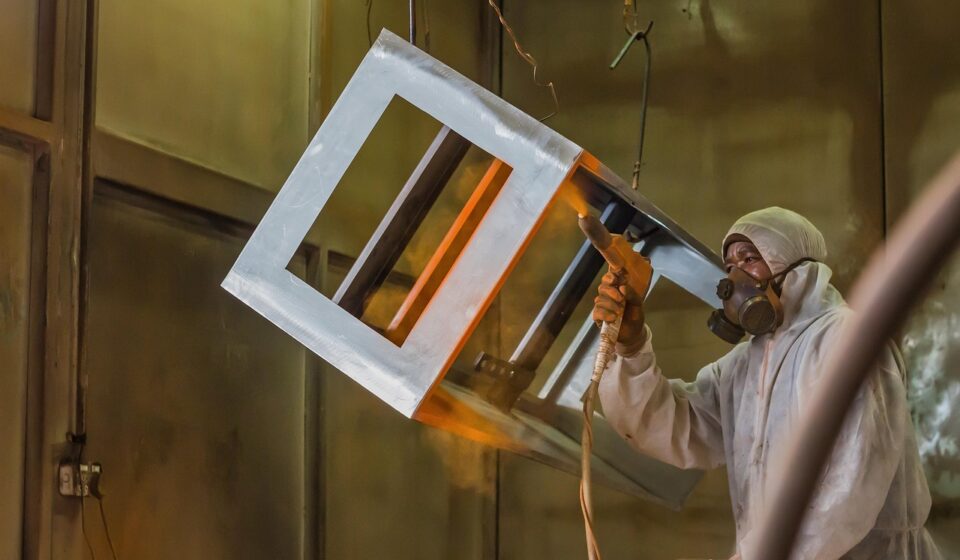
Spray processes can expose workers to solvents, pigments, metals, dusts, polyisocyanates and other hazardous substances, depending on the coating. NIOSH guidance on paint overspray emphasizes that exposure control requires a combination of proper spray equipment selection, a properly designed and ventilated spray booth, and personal protective equipment. The U.K. Health and Safety Executive also warns that isocyanate spraying can produce very high exposure and commonly calls for controlled spray areas and suitable respiratory protection, often air-fed equipment for higher-risk spray tasks.
Safety planning should begin with the safety data sheet and the coating supplier’s technical data. Confirm whether the material is flammable, combustible, sensitizing, carcinogenic, corrosive or reactive. Then confirm whether the booth, gun, pump, hose, grounding, ventilation, respirator program, protective clothing and cleaning method match those hazards. Airless systems need particular attention because high-pressure fluid injection injuries can be severe even when the coating is not highly toxic.
- Confirm that operators are trained on startup, spraying, shutdown, cleaning and emergency procedures.
- Use the correct filters, separators and air dryers for compressed air quality.
- Inspect hoses, fittings, seals, grounding cables and gun tips on a planned schedule.
- Track filter loading and replace filters before airflow and finish quality decline.
- Manage gun cleaning to reduce evaporation, spills and worker exposure.
- Keep overspray deposits, powder accumulations and combustible residues under control.
Environmental requirements vary by jurisdiction and industry. Some sites need emission controls, hazardous waste procedures, wastewater controls or specific recordkeeping. Treat these requirements as part of equipment ownership cost, not as afterthoughts.
A practical specification checklist
When comparing suppliers or preparing an internal capital request, use a checklist that forces measurable answers. Start with the part envelope: maximum dimensions, weight, material, grounding method and surfaces to be coated. Define throughput: parts per hour, shifts per day, color changes, batch size and acceptable downtime. Then define coating targets: finish appearance, dry film thickness range, corrosion category, cure schedule and rework tolerance.
Next, specify the application package. Include pump ratio or delivery method, gun type, tip range, fluid hose compatibility, air control, pressure monitoring, material agitation, plural-component mixing if needed, flushing method and spare parts. For automated lines, include robot reach, path control, recipe management, part detection, conveyor speed, masking strategy and access for maintenance.
Finally, specify the controlled environment. Include booth type, exhaust and makeup air concept, filtration, fire protection review, lighting, noise, operator position, inspection stations, curing or drying equipment, and waste handling. Ask vendors to provide acceptance criteria for a trial: film build, appearance, transfer performance, cycle time, cleaning time and defect rate. A short production trial with actual parts and the actual coating is more useful than a broad claim about what a system can do in theory.
Frequently asked questions
What is the best spraying equipment for industrial coating?
There is no universal best option. HVLP, airless, air-assisted airless, electrostatic, powder and robotic systems all fit different applications. The best choice is the one that meets the required film build, finish appearance, throughput, safety controls and compliance obligations for the actual parts being coated.
Is HVLP always better than airless spraying?
No. HVLP can be a strong choice for controlled finishing and transfer efficiency, especially on smaller or cosmetic parts. Airless spraying is often better for high-output coating of large surfaces and heavy protective coatings. Air-assisted airless can be a middle ground when both output and appearance matter.
When does electrostatic spraying make sense?
Electrostatic spraying is most useful when parts are conductive, consistently grounded and shaped in a way that benefits from wraparound deposition. It is less suitable when grounding is unreliable, parts are highly recessed, materials are incompatible or fire-safety controls cannot be maintained.
Can new spraying equipment fix adhesion failure?
Usually not. Adhesion problems are often caused by contamination, poor surface preparation, incorrect profile, wrong coating mix, missed recoat windows or poor curing conditions. Equipment tuning can improve atomization and film build, but it cannot replace proper surface preparation and inspection.
How should a factory maintain spraying equipment?
Maintenance should follow the equipment manufacturer’s manual and site safety procedures. Typical tasks include cleaning guns and tips, checking seals and hoses, verifying pressure controls, draining moisture from air systems, replacing filters, confirming grounding and recording any changes that affect coating quality.