Material handling equipment for safer and more efficient warehouses in 2026
Why equipment choice matters now
Material handling equipment is no longer just a set of forklifts, pallet jacks, racks and conveyors. In 2026, it is part of a wider warehouse operating system that affects safety, labor planning, throughput, inventory accuracy and automation readiness. A sound specification starts with how goods actually move: load size, travel distance, pick frequency, storage density, worker interaction and maintenance capacity.
Public sources including OSHA, the Bureau of Labor Statistics and the 2026 MHI Annual Industry Report show why the decision deserves close attention. Warehouse hazards remain a major enforcement and injury concern, while supply chain leaders are investing in automation, robotics and real-time data to manage labor and service pressures. For more related topics, see the material handling category.
What counts as material handling equipment
Material handling equipment covers the tools, machines and systems used to move, store, control, protect and position materials through manufacturing plants, warehouses, distribution centers and loading areas. A practical way to classify it is by the work it performs inside the operation, not by a supplier’s product catalog.
Transport equipment
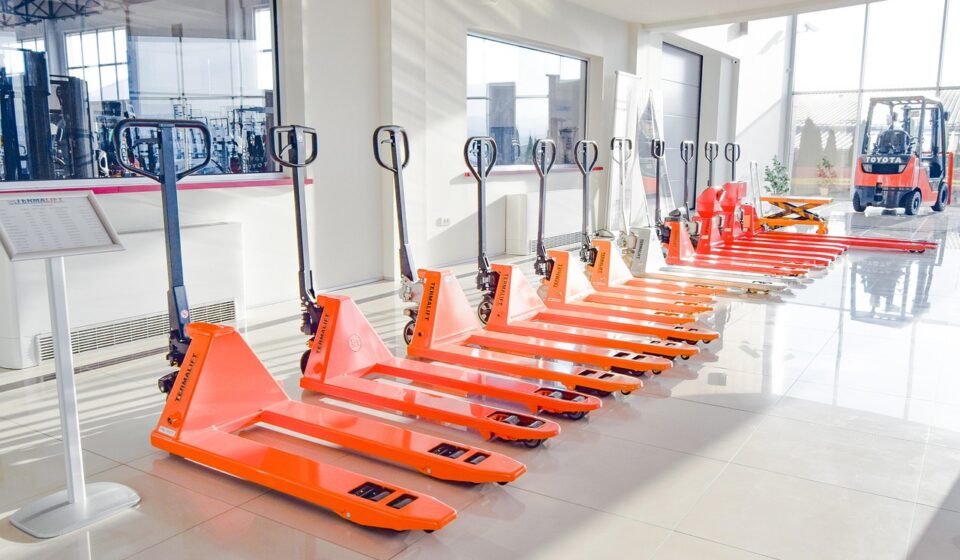
Transport equipment moves goods from one point to another. Common examples include forklifts, pallet jacks, tugger carts, carts, dollies, conveyors, automated guided vehicles and autonomous mobile robots. The right choice depends on travel distance, aisle width, floor condition, load stability, turning radius, traffic patterns and the number of worker interactions along the route.
Storage and unit load equipment
Storage equipment includes pallet racking, shelving, bins, mezzanines, flow racks and automated storage and retrieval systems. Unit load equipment includes pallets, containers, totes and returnable packaging. These assets determine whether materials are stable, accessible and protected. They also influence pick speed, slotting strategy and forklift traffic.
Lifting and positioning equipment
Lifts, hoists, cranes, scissor tables, manipulators, turntables and tilters bring the load to the right height or orientation. This category is especially important where workers handle awkward, heavy or repetitive loads. OSHA ergonomics guidance has long emphasized engineering controls such as mechanical lifting aids, height adjustment and reduced reach distances because these controls change the physical task rather than relying only on worker behavior.
Identification and control systems
Modern material handling equipment increasingly includes scanners, sensors, warehouse control systems, machine guarding, fleet management software and maintenance data. These systems do not carry the load by themselves, but they direct where goods go, verify movement and help supervisors understand bottlenecks, downtime and safety events.
Match equipment to flow, load and risk
A common mistake is to compare machines before mapping the work. A fast conveyor can create congestion if upstream receiving is inconsistent. A forklift fleet may look flexible but become expensive when long travel distances and pedestrian crossings dominate the day. A robot pilot can fail if the facility has poor location discipline, damaged floors or unstandardized packaging.
| Operating condition | Equipment types often considered | Main advantage | Key limitation to check |
|---|---|---|---|
| Short, occasional pallet moves | Manual or electric pallet jacks | Low complexity and flexible use | Ergonomic strain, floor condition and battery maintenance |
| High pallet throughput with vertical storage | Counterbalance forklifts, reach trucks, turret trucks | Strong lift capacity and storage access | Operator training, aisle design, rack protection and pedestrian separation |
| Repeating carton or tote movement | Belt, roller or sortation conveyors | Consistent flow and reduced walking | Accumulation points, guarding, maintenance access and layout inflexibility |
| High SKU density and limited floor space | Flow racks, vertical lift modules, AS/RS | Space utilization and controlled access | Capital cost, integration and recovery plan if the system stops |
| Variable routes in a changing warehouse | Autonomous mobile robots or tugger systems | Flexible travel paths and scalable deployment | Traffic management, charging, software integration and exception handling |
| Heavy or awkward manual tasks | Hoists, lift tables, manipulators, tilters | Reduced force, reach and awkward posture | Cycle time, operator acceptance and compatibility with packaging |
The best equipment decision often combines categories. A warehouse may use forklifts for receiving, conveyors for predictable carton flow, lift tables for ergonomic packing and mobile robots for replenishment. The goal is not to automate everything. It is to remove the most damaging constraints first: unsafe lifts, long travel paths, congestion, mis-picks, poor slotting and unplanned downtime.
Safety and compliance should shape the specification
Safety is not an add-on after equipment is installed. It should shape the layout, guarding, traffic rules, visibility, maintenance access and operator training plan from the beginning. OSHA identifies warehousing hazards associated with powered industrial trucks, ergonomics, material handling, slips, trips, falls, hazardous chemicals and robotics. OSHA also notes that common warehouse injuries include musculoskeletal disorders from overexertion and struck-by incidents involving powered industrial trucks or other material handling equipment.
BLS 2024 injury and illness tables reported 77.0 thousand nonfatal cases in the warehousing and storage industry, including 72.9 thousand in general warehousing and storage. The same BLS release listed a 3.1 incidence rate for material handling equipment manufacturing, with higher listed rates for overhead traveling crane, hoist and monorail system manufacturing and for industrial truck, tractor, trailer and stacker machinery manufacturing. These figures do not prove that a specific machine is unsafe, but they show that equipment-intensive environments require disciplined controls.
OSHA’s updated National Emphasis Program on Warehousing and Distribution Center Operations became effective on July 31, 2026. The directive focuses inspections on hazards such as powered industrial vehicle operations, material handling and storage, walking-working surfaces, means of egress, heat, ergonomics and fire protection. For equipment buyers and facility managers, the practical takeaway is clear: documentation, training, maintenance records, traffic separation and rack condition should be treated as part of the equipment system.
For forklifts and other powered industrial trucks, OSHA’s 29 CFR 1910.178 requirements make operator training and evaluation central to safe use. Facilities should also verify rated loads, load centers, attachments, charging or fueling areas, visibility, audible warnings, floor condition and the interaction between trucks and pedestrians. For racking and storage, load capacity signage, upright protection, damage isolation and stable stacking are just as important as the nominal capacity of the rack beam.
Automation is shifting from isolated machines to connected systems
Automation in material handling used to mean a dedicated conveyor line or a high-end automated storage system. That is changing. The 2026 MHI Annual Industry Report, prepared with Deloitte and based on survey responses from more than 500 supply chain leaders received in December 2025, points to a broader shift toward connected, intelligent and automated networks. See also: production equipment.
MHI’s 2026 reporting highlighted talent acquisition and workforce challenges as the top company-level supply chain challenge at 58%. It also identified accurate forecasting and inventory management at 48% and evolving customer demands at 46%. These pressures help explain why companies are looking beyond single pieces of equipment toward systems that can improve labor productivity, inventory visibility and execution speed.
The same MHI reporting described rapid expected adoption of digital and automated technologies. AI was expected to be implemented by 88% of organizations within five years, while robotics and automation were expected to reach 73% adoption within five years. For material handling equipment, this does not mean every facility needs advanced robotics immediately. It means new equipment should be evaluated for data readiness: can it share status, accept instructions, integrate with a warehouse management system, support preventive maintenance and operate safely around people?
In practice, the strongest near-term opportunities are often practical rather than futuristic. Examples include forklift fleet monitoring, conveyor downtime alerts, barcode or RFID verification, automated dimensioning, pick-to-light systems, AMR-assisted transport and lift-assist equipment at high-strain workstations. These tools can improve flow without requiring a full facility redesign, provided the process data and ownership model are clear.
A practical selection checklist for 2026 projects
Before requesting quotes or comparing brands, define the operational problem in measurable terms. A facility trying to reduce injuries needs a different equipment mix than one trying to increase order cutoff time or compress storage space. The checklist below can help teams avoid under-specified projects.
- Map the material flow from receiving to storage, picking, packing, staging and shipping.
- Record load dimensions, weight ranges, packaging type, center of gravity and damage sensitivity.
- Measure travel distances, aisle widths, turning points, dock congestion and pedestrian crossings.
- Separate peak demand from average demand so the system is not designed around the wrong volume.
- Identify manual lifts, reaches, pushes, pulls and repetitive motions that create ergonomic risk.
- Check floor flatness, rack condition, door clearances, lighting, charging areas and fire protection constraints.
- Confirm operator training needs, lockout procedures, inspection routines and spare parts availability.
- Define integration requirements with warehouse management, control, maintenance and labor systems.
- Estimate total cost of ownership, including energy, maintenance, downtime, training and layout changes.
- Plan a fallback procedure for equipment failure, software downtime or demand spikes.
The most credible business case connects each equipment choice to a specific operational metric. A lift table may reduce shoulder-height handling at a packing station. A conveyor may cut walking time between pick zones and sortation. A reach truck may increase storage density but require stronger aisle discipline and rack protection. A robot fleet may reduce travel labor, but only if pick faces, traffic rules and exception workflows are ready.
Common mistakes to avoid
- Buying capacity without validating the heaviest and most awkward loads.
- Automating a process that has inaccurate inventory data or inconsistent packaging.
- Ignoring pedestrian traffic until after forklifts, conveyors or robots are installed.
- Choosing storage density that slows replenishment or creates unsafe access.
- Underestimating maintenance access, battery charging, spare parts and technician skills.
- Treating training as a one-time event rather than an ongoing part of the equipment program.
What to watch next
The next phase of material handling equipment will be shaped by three linked forces. First, safety scrutiny in warehouse and distribution operations remains active, especially around powered industrial vehicles, storage practices, ergonomics and walking-working surfaces. Second, labor constraints are pushing facilities to remove low-value travel and repetitive strain from daily work. Third, automation is becoming more connected, which raises the value of clean data, stable processes and interoperable equipment.
For many facilities, the smart move is not to chase the most advanced machine first. It is to create a staged roadmap: stabilize storage and traffic, reduce high-risk manual handling, collect reliable movement data, then automate the flows that are repetitive enough to justify the investment. Material handling equipment delivers the most value when it is selected as part of a system that includes people, process, layout, safety and information flow.
Frequently asked questions
What are the main types of material handling equipment?
The main types are transport equipment, storage equipment, lifting and positioning equipment, unit load equipment and identification or control systems. In real facilities, these categories often work together. A pallet may move by forklift, be stored in racking, be verified by barcode and be transferred to a conveyor or packing station later in the process.
How do you choose the right material handling equipment?
Start with the load and the flow. Identify what is being moved, how often it moves, how far it travels, who interacts with it and what safety risks exist. Then compare equipment based on throughput, space, ergonomics, training, maintenance, integration and total cost of ownership rather than purchase price alone.
Is automation always better than manual handling equipment?
No. Automation is valuable when the process is repeatable, data is reliable and the expected volume justifies the investment. Manual or semi-automated equipment can be better for low-volume, variable or frequently changing operations. Many facilities get the best result from a hybrid approach.
Why is ergonomics important in material handling?
Ergonomics matters because many material handling tasks involve lifting, lowering, reaching, pushing, pulling and repetition. Engineering controls such as lift tables, tilters, hoists and better workstation height can reduce physical stress and make the job fit the worker rather than forcing the worker to compensate for poor layout.