How to evaluate material handling equipment manufacturers for safer, smarter operations

Why manufacturer selection is a specification decision
Choosing material handling equipment manufacturers is more than a sourcing exercise based on catalog range, price, and lead time. The manufacturer’s role affects how well equipment is matched to load characteristics, travel paths, duty cycles, operator safety, maintenance resources, and future automation plans. A forklift, conveyor, scissor lift, rack interface, or autonomous mobile robot can become a long-term operating constraint if it is underspecified, poorly integrated, or difficult to service.
For industrial buyers, the practical goal is not to find a universal “best” supplier. It is to identify manufacturers whose documented capabilities fit a specific plant, warehouse, or distribution operation. This article focuses on evidence buyers can verify before issuing a purchase order. It is intended for teams comparing manufacturers, preparing specifications, or reviewing procurement risks in the broader material handling category.

What buyers usually mean by material handling equipment
The phrase “material handling equipment” covers a wide range of products, so the right manufacturer profile depends on the movement problem. In a production plant, the priority may be safe lift-and-position equipment at an assembly cell. In a warehouse, it may be storage, picking, pallet movement, or dock flow. In a distribution center, it may include conveyors, sorters, autonomous mobile robots, automated storage and retrieval systems, or software-connected picking systems.
Most buyer shortlists fall into several overlapping groups:
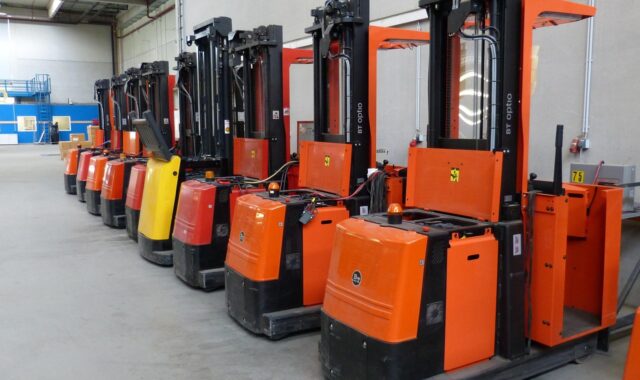
- Industrial trucks and mobile equipment, including forklifts, pallet trucks, tow tractors, order pickers, and reach trucks.
- Conveyor and sortation equipment, including belt, roller, chain, accumulation, spiral, and automated sortation systems.
- Lifting and positioning equipment, including lift tables, scissor lifts, tilters, turntables, hoists, and workstation assist devices.
- Storage and rack-related systems, including pallet racking, shelving, mezzanines, flow rack, and integrated pick modules.
- Automated and robotic systems, including automated guided vehicles, autonomous mobile robots, robotic palletizing, automated storage systems, and control software.
A manufacturer that is strong in one category may not be qualified for another. A supplier with deep experience in ergonomic lift tables, for example, may not be the right source for fleet-scale autonomous vehicles. The first buying task is therefore to define the movement, load, environment, and control requirements before comparing brand names.
Evidence that separates qualified manufacturers from general equipment sellers
Documented compliance and safety alignment
For U.S. operations, safety evidence is often the first filter. OSHA’s powered industrial truck rules require operator training, appropriate truck use, and regular equipment examination, including daily examination of forklifts before they are placed in service. OSHA also states that unsafe powered industrial trucks must be removed from service until restored to safe operating condition. These requirements do not make OSHA a product certifier, but they do shape what buyers should request from manufacturers: clear manuals, nameplates, rated capacity information, maintenance instructions, inspection points, and training support.
Standards also matter by equipment type. Industrial scissor lifts are commonly associated with ANSI MH29.1 safety requirements. Driverless industrial trucks and their systems are addressed by ISO 3691-4, which covers equipment such as automated guided vehicles, autonomous mobile robots, automated guided carts, and related driverless truck systems. Buyers should ask which standards apply to the exact product configuration being proposed, not just to the product family in general.
Capacity, stability, and load documentation
Capacity claims need to be specific. A safe working load or rated capacity is not meaningful without context such as load center, lift height, platform size, travel speed, gradient, attachment type, duty cycle, and operating surface. For forklifts and lift equipment, modifications or added attachments can change capacity and safe operation. A credible manufacturer or authorized distributor should provide updated documentation when attachments, controls, or structural elements affect the equipment’s rated performance.
Buyers should avoid broad claims such as “heavy duty” or “warehouse grade” unless the supplier can support them with documented assumptions. A stronger specification states the maximum load, load dimensions, center of gravity assumptions, daily cycles, operating hours, aisle width, battery or power requirements, and environmental conditions. The more variable the load, the more important it becomes to involve the manufacturer’s application engineering team.
Application engineering, not just product matching
Manufacturers with strong application support ask detailed questions before quoting. They may request facility drawings, pallet data, throughput targets, dock conditions, traffic patterns, rack clearances, operator tasks, and maintenance practices. This is not administrative friction; it is a sign that the supplier is checking whether the equipment will work in the real operating environment.
For automated systems, application engineering also includes software and controls. Buyers should ask how the system interfaces with a warehouse management system, warehouse control system, enterprise resource planning platform, fleet manager, safety scanner, charging system, or programmable logic controller. A manufacturer that cannot explain these interfaces clearly may create integration risk, even when the mechanical equipment is sound.
Automation is changing the shortlist but not replacing fundamentals
As of October 2026, automation is no longer a niche consideration in material handling procurement. Public summaries of the 2026 MHI Annual Industry Report, produced with Deloitte, indicate that the report surveyed more than 500 supply chain professionals and found significant interest in artificial intelligence, robotics, and automation. Reported summaries indicate that 35% of organizations were already using robotics and automation, with another 38% expecting adoption within five years. The same report cycle also highlighted budget constraints, business-case clarity, and workforce challenges as important barriers.
These figures do not mean every facility should automate immediately. They do mean that buyers comparing material handling equipment manufacturers should consider whether a supplier’s equipment can support future automation, data capture, or phased upgrades. A manually operated conveyor, lift, or truck fleet may still be the right purchase. Even then, the manufacturer should be able to explain what happens if throughput increases, order profiles change, labor availability tightens, or the site later adds automation.
For autonomous mobile robots, automated guided vehicles, and driverless industrial trucks, evaluation needs to go beyond vehicle payload. Buyers should review fleet management, mapping, traffic control, obstacle detection, battery strategy, safety validation, uptime support, cybersecurity responsibilities, and change-management requirements. Automation can improve flow when it is engineered around the process. It can also expose weak layouts, poor master data, and inconsistent operating procedures.
A practical comparison framework for manufacturers
The table below gives procurement, engineering, and operations teams a way to compare manufacturers without relying on unsupported rankings or generic vendor claims. See also: production equipment.
| Evaluation area | What to verify | Why it matters |
|---|---|---|
| Product fit | Load size, weight, center of gravity, throughput, aisle, dock, and floor conditions | Prevents undercapacity, unsafe use, and premature wear |
| Safety documentation | Manuals, inspection points, rated capacity plates, warnings, training material, and applicable standards | Supports safer operation and regulatory alignment |
| Application engineering | Site review, drawings, layout assumptions, simulation, or cycle calculations where appropriate | Reduces the risk of buying equipment that works on paper but not in the facility |
| Integration capability | Controls, sensors, software interfaces, data access, and automation roadmap | Determines whether the equipment can scale with future operational needs |
| Service and parts | Spare parts availability, technician coverage, preventive maintenance plans, and response time | Protects uptime after installation |
| Total cost | Energy use, consumables, maintenance, training, downtime exposure, and expected service life | Reveals costs that may not appear in the purchase price |
This framework is especially useful when comparing a low-cost quote with a higher-priced proposal. A lower initial price may be justified if the application is simple, the equipment is standard, and service support is adequate. It becomes risky when documentation is thin, application assumptions are unclear, or replacement parts are difficult to obtain.
Questions to ask before contacting manufacturers
Good questions make vendor responses easier to compare. Before contacting manufacturers, buyers should prepare a short operating brief that answers the following points:
- What materials, pallets, containers, or components will the equipment handle?
- What are the maximum and typical load weights, dimensions, and centers of gravity?
- How many moves, lifts, picks, transfers, or cycles are expected per shift?
- What are the floor conditions, gradients, aisle widths, ceiling heights, rack clearances, and dock constraints?
- Will operators share the area with pedestrians, forklifts, robots, cranes, or conveyors?
- What power source is preferred, and are there charging, ventilation, or battery-handling constraints?
- What standards, customer requirements, or internal safety procedures must the equipment support?
- Who will maintain the equipment, and what spare parts must be held on site?
- Could the process need automation, data collection, or higher throughput within the next three to five years?
The answers help manufacturers provide a more accurate recommendation. They also help buyers identify generic proposals. If two suppliers receive the same operating brief and only one responds with capacity calculations, layout comments, and service assumptions, that difference is meaningful.
Red flags when reviewing manufacturer proposals
Several warning signs should slow the procurement process. One is an unsupported “best manufacturer” claim. Public rankings often mix distributors, integrators, equipment categories, and sponsored listings, so they may not reflect technical fit. Another warning sign is a proposal that does not state application limits. A quote should not simply name a model; it should define the assumptions under which that model is suitable.
Buyers should also be cautious when a manufacturer cannot provide manuals, replacement part information, nameplate details, electrical documentation, control architecture, or service contacts before purchase. For automated systems, vague language around software ownership, data access, cybersecurity updates, and integration responsibility can become expensive later. For custom equipment, unclear acceptance criteria can create disputes at installation.
Finally, short lead time should not override safety and maintainability. Fast delivery is valuable only if the equipment fits the process and can be supported throughout its service life.
Frequently asked questions
Are material handling equipment manufacturers and distributors the same thing?
No. A manufacturer designs or produces the equipment, while a distributor sells, supports, and may install equipment from one or more manufacturers. In many projects, an authorized distributor or systems integrator is the buyer’s main contact. The key is to confirm who is responsible for design assumptions, warranty, documentation, service, and post-installation support.
Should buyers choose a specialized manufacturer or a broad-line supplier?
It depends on the application. Specialized manufacturers may offer deeper engineering knowledge for lifts, conveyors, robotics, or storage systems. Broad-line suppliers may simplify procurement and service across a mixed fleet. For complex or safety-critical applications, demonstrated experience with the exact equipment type is usually more important than catalog size.
How important are standards when comparing manufacturers?
Standards are important because they give buyers a way to discuss safety, design, testing, and documentation using recognized references. However, standards must be tied to the exact equipment and application. Buyers should ask manufacturers to identify the relevant standards and explain how the proposed configuration addresses them.
Is automation always the better choice for material handling?
No. Automation can improve consistency, throughput, and labor utilization when the process is stable and well defined. It may not be the right first investment if layouts are changing, data is poor, volumes are uncertain, or maintenance resources are limited. A good manufacturer will explain both the benefits and the operating limits of an automated solution.
What is the most useful first step in comparing manufacturers?
Create a written application brief before requesting quotes. Include load data, throughput, facility constraints, safety requirements, service expectations, and future growth plans. This makes manufacturer responses easier to compare and reduces the risk of choosing equipment based only on price or availability.