Material handling supply planning for safer and more resilient operations

What material handling supply covers
Material handling supply covers the equipment, consumables, controls, spare parts, and support services used to move, store, protect, count, and ship goods inside industrial facilities. It is not simply a buying list. Each item should be tied to load size, travel path, storage density, worker safety, maintenance access, and throughput targets. For manufacturers, warehouses, distributors, and logistics sites, the practical objective is to keep material moving with fewer touches, fewer delays, and fewer uncontrolled risks.
The term can include forklifts, pallet trucks, casters, conveyors, lift tables, hoists, dock equipment, racks, bins, pallets, carts, guards, labels, batteries, chargers, sensors, warehouse software interfaces, and replacement parts. It also includes decisions about standardization. Two similar facilities may use the same equipment category but require different specifications because floor condition, aisle width, load stability, shift pattern, and operator training are not the same.

For more coverage of industrial equipment and handling systems, visit the material handling category.
Why supply choices affect more than purchasing cost
Material handling sits between production, storage, maintenance, and shipping. When a pallet jack, charger, rack beam, dock leveler, or conveyor section fails, the result is not only a repair invoice. It can interrupt picking, delay outbound trucks, block aisles, increase manual handling, and push workers toward unsafe shortcuts.
For that reason, procurement teams should treat material handling supply as part of the operating system. Price matters, but it is only one part of value. The better question is whether the selected supply can carry the intended load, survive the duty cycle, fit the working environment, remain maintainable, and be used safely by trained personnel. A lower purchase price can disappear quickly if batteries are mismatched, parts are hard to source, rack damage is frequent, or operators must work around poor visibility and tight turning areas.
Recent safety data reinforces the point. The U.S. Bureau of Labor Statistics reported 5,070 fatal work injuries in the United States in 2024. Transportation and material moving occupations represented the occupational group with the most fatalities, with 1,391 fatal work injuries and a rate of 12.5 fatalities per 100,000 full-time equivalent workers. These figures do not mean every warehouse has the same risk profile, but they do show why equipment selection, traffic control, storage stability, and training should be considered before a purchase order is issued.
Build the supply list around material flow
A reliable plan starts with the actual path material takes through the facility. Catalog categories are useful, but they should not drive the decision. Start with receiving, then follow the load through staging, inspection, storage, replenishment, picking, packing, and shipping. At each point, identify what is being moved, how often it moves, how heavy it is, how fragile it is, and where delays usually occur.
Receiving and dock areas
Dock equipment and staging supplies are often overlooked until bottlenecks appear. Dock levelers, bumpers, wheel restraints, yard signs, floor markings, stretch wrap stations, portable ramps, pallet inverters, and scale systems can determine whether inbound material is processed smoothly or piles up in a congested area. Selection should account for trailer types, dock height, weather exposure, traffic volume, and the need to separate pedestrians from powered industrial trucks.
Storage and replenishment
Storage supplies include pallet rack, shelving, flow rack, bins, totes, dividers, guards, rack labels, and inventory identification systems. The main trade-off is density versus accessibility. High-density storage can reduce floor space, but it may also increase retrieval time or require specialized trucks. For fast-moving stock, visibility and picking speed may matter more than maximum storage density.
Movement, picking, and shipping
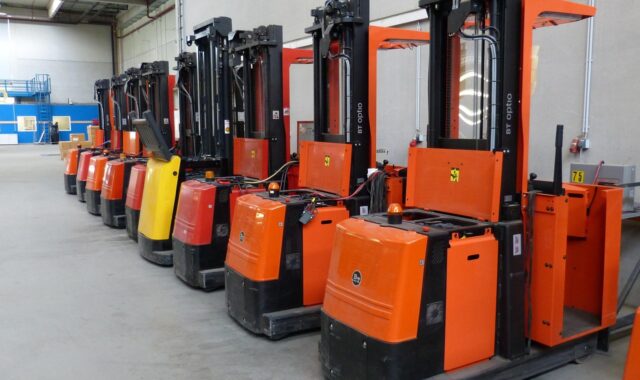
The movement layer includes forklifts, reach trucks, pallet trucks, carts, tuggers, conveyors, sortation, lift assists, and automated mobile robots. The right mix depends on travel distance, order profile, labor availability, load type, and facility layout. Shipping supplies such as pack benches, carton flow, scales, printers, label applicators, strapping tools, and stretch wrapping equipment should be selected together because they influence the final pace of order release.
Evaluation criteria before selecting suppliers
Supplier evaluation should be evidence-based. A buyer does not need a complex scoring model for every small purchase, but high-use or safety-critical supplies deserve structured review. The following matrix is a practical starting point.
| Decision area | Questions to ask | Evidence to request |
|---|---|---|
| Load and capacity | What is the maximum load, center of gravity, size range, and handling method? | Rated capacity, specification sheet, application notes, and compatibility limits |
| Environment | Will the item operate in cold storage, dust, moisture, outdoor yards, food zones, or hazardous areas? | Material grade, enclosure rating, tire type, finish, approved use conditions, and maintenance requirements |
| Duty cycle | How many shifts, moves, starts, lifts, charges, or cycles will occur each day? | Expected service life, battery or motor data, cycle ratings, warranty terms, and replacement intervals |
| Safety fit | Does the supply support clear aisles, stable storage, guarding, visibility, and operator control? | Risk assessment, manuals, inspection points, training needs, and applicable standards |
| Maintainability | Can maintenance teams inspect, clean, adjust, and repair the item without excessive downtime? | Parts list, service instructions, lead times, diagnostic access, and local support availability |
| System integration | Does it connect with existing conveyors, chargers, racks, WMS, labels, sensors, or automation plans? | Interface requirements, dimensions, data formats, controls documentation, and installation drawings |
This matrix also helps compare a local distributor, a national catalog supplier, and a specialized OEM. A distributor may offer faster support and familiar parts. An OEM may provide deeper engineering support for complex systems. A catalog source may be suitable for standard consumables. The right choice depends on risk, complexity, lead time, and how difficult the item is to replace.
Safety and compliance checkpoints
Safety should be built into the purchasing process, not added after equipment arrives. OSHA 29 CFR 1910.176 addresses general materials handling and storage requirements in U.S. workplaces. It covers safe clearances where mechanical handling equipment is used, clear and marked aisles, stable storage, housekeeping, clearance signs, and guarding for hazards such as open pits or vats. These requirements are operational, but supply decisions influence whether a facility can meet them.
Powered industrial trucks bring additional requirements under OSHA 29 CFR 1910.178. Employers must ensure operators are competent through training and evaluation before operating powered industrial trucks. OSHA describes training as a combination of formal instruction, practical training, and workplace performance evaluation. The standard also requires an evaluation of each operator’s performance at least once every three years and refresher training under specified conditions, such as unsafe operation or workplace changes.
These rules have direct purchasing implications. A new truck type may require training updates. A battery charging area may need ventilation, fire protection, spill response supplies, and protection from truck impact. Narrower aisles may require different equipment, markings, mirrors, pedestrian controls, or traffic rules. A modified attachment can change load capacity and safe operation. A supply plan that ignores these details can create compliance and safety gaps even when the equipment itself appears suitable. See also: production equipment.
Lifecycle cost is the more useful comparison
For material handling supply, total cost of ownership is usually more useful than unit price. A lifecycle cost view includes purchase price, installation, operator training, energy, consumables, inspection labor, planned maintenance, unplanned downtime, spare parts, repair response, disposal, and productivity effect. This is especially important for batteries, chargers, lift trucks, conveyors, pallet flow systems, dock equipment, and automation components.
Consider a forklift battery decision. The purchase price is visible, but charging time, charger compatibility, ventilation needs, watering requirements, maintenance labor, and battery change method can have a larger operational effect. The same logic applies to conveyors. A low-cost conveyor section can become expensive if belts, rollers, sensors, or controls are not standardized with the rest of the line. Rack protection is another example. Column guards, end-of-aisle protectors, and inspection routines add cost, but they can reduce damage and help maintain storage stability.
Procurement teams can improve resilience by classifying supplies into three groups. Critical items stop operations or create safety exposure when unavailable. Standard operating items affect productivity but have substitutes. Commodity items are low-risk consumables. Critical items deserve spare parts planning, approved alternates, preventive inspection, and supplier performance tracking. Commodity items can be managed mainly through reorder points and price discipline.
Automation and data readiness are changing the supply mix
Material handling supply is no longer limited to mechanical hardware. Automation, sensing, and software connectivity now influence many equipment decisions. MHI’s recent annual industry reporting with Deloitte has emphasized digital supply chain technology, robotics, automation, and end-to-end orchestration. In 2025 industry coverage, MHI reported that surveyed supply chain leaders expected strong five-year adoption of robotics and automation, with 83 percent cited for that category.
This does not mean every facility should automate immediately. Automation works best when the process is stable enough to define, measure, and repeat. Before buying automated mobile robots, conveyor sortation, automated storage, vision systems, or advanced picking tools, a facility should confirm data quality, SKU profiles, order variability, floor condition, charging strategy, pedestrian routes, maintenance skills, and system ownership. Automating a disorganized process can simply make the disorder more expensive.
A practical approach is to make today’s manual or semi-automated supply choices flexible enough for tomorrow’s upgrades. Examples include using consistent pallet sizes where possible, improving location labeling, keeping aisles and dock areas measurable, selecting carts or containers that match future conveyor dimensions, and choosing controls or scanners that can share data with warehouse systems. Readiness often starts with standardization, not robots.
A practical material handling supply checklist
Use this checklist before approving a major purchase or changing a standard supply item:
- Map the material flow and identify the exact handling step the supply will improve.
- Confirm maximum load, load stability, dimensions, and center of gravity.
- Check aisle width, turning radius, dock conditions, floor condition, door clearances, and storage height.
- Review OSHA-related implications for storage, aisles, guarding, powered industrial trucks, battery charging, and operator training.
- Ask whether the item supports pedestrian separation, visibility, markings, and housekeeping.
- Compare lifecycle cost, not only purchase price.
- Confirm replacement parts, service support, warranty limitations, and expected lead time.
- Decide whether the item should be standardized across sites or tailored to one process.
- Record training, inspection, and maintenance responsibilities before installation.
- Review whether the decision supports future automation, data capture, or layout changes.
The strongest supply plans are not the ones with the most equipment. They are the plans that remove unnecessary touches, protect workers, reduce maintenance surprises, and keep material moving predictably. In industrial operations, that combination is often worth more than a narrow focus on the lowest purchase price.
Frequently asked questions
What is included in material handling supply?
It can include equipment such as forklifts, pallet trucks, racks, conveyors, hoists, carts, lift tables, dock equipment, bins, pallets, labels, guards, batteries, chargers, and spare parts. It can also include supporting technology such as sensors, barcode systems, and warehouse software interfaces.
How should a facility choose between manual, powered, and automated handling?
The decision should depend on load weight, travel distance, order volume, labor availability, variability, safety exposure, and process stability. Manual tools may be suitable for low-volume tasks. Powered equipment fits heavier or more frequent moves. Automation is most effective when the process is repeatable, data is reliable, and maintenance ownership is clear.
Why is OSHA relevant to material handling supply decisions?
OSHA requirements influence aisle clearance, storage stability, housekeeping, guarding, powered industrial truck use, operator training, and battery charging practices. These requirements affect equipment selection, layout, signage, training plans, and maintenance routines.
What is the biggest mistake in material handling purchasing?
The most common mistake is buying by equipment category instead of by workflow need. A supply item should be selected because it solves a defined handling problem, fits the environment, supports safe operation, and can be maintained throughout its service life.